Why Carpets Show Shading and Footprints
A large part of my carpet cleaning involves cleaning carpets that are almost new. Both carpet retailers and homeowners employ me to carry out professional carpet cleaning as part of the maintenance required by the manufacturer's warranty, which means that I end up cleaning a great deal of carpet that has only had a little use on it. On these jobs, one question is asked more often than any other: the owner points to a dark spot which appears to be a spill, or to footprints that won't come out with brushing, and asks, "It's new, why is it doing that?"
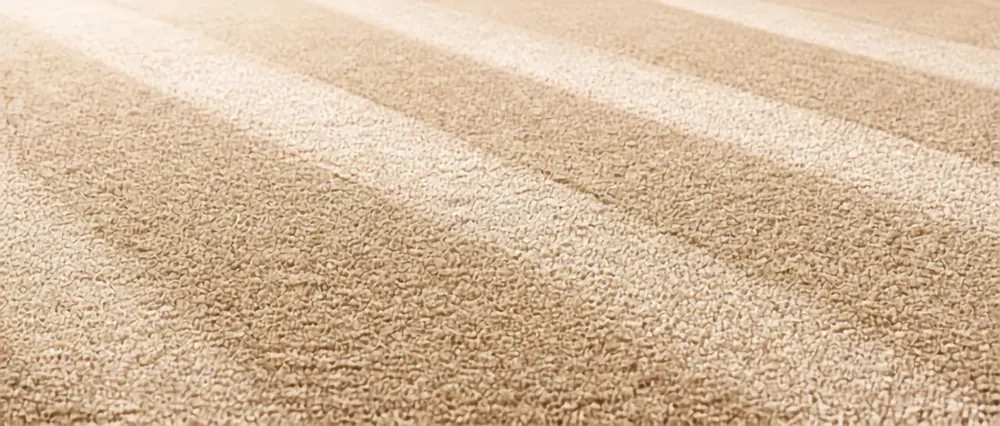
The carpet is not defective; none of the colors have changed, and no fibers have worn out. The pile lies in various directions, and light reflects off a curved fiber in a different way from a straight one. The eye interprets this difference as areas of light and shade. This effect has a name, carpet shading, and there are a few types that should be distinguished. Two of these are harmless and temporary. The third is generally permanent, and it is the one which leads people to think that their new carpet has been ruined.
What Is Carpet Shading?
With a carpet that has shading, the pile has ceased to lie in a single uniform direction; nothing else is different. The light reflects off the sides of the tilted fibers and on the points of the standing ones, and the eye perceives this difference as a dark spot or a light streak. Dye has nothing to do with the situation.
Velvet shows the same behavior. If you run your hand over it, the path left by your fingers will appear darker than the fabric nearby, even though you know perfectly well that you haven't stained it at all. A tuft on a carpet bends in the same way whether you press on it with the heel of your shoe or with a vacuum cleaner brush, and it remains bent until it is straightened again.
If you go into almost any house that I work in, you will be able to see the full range of flooring within a single visit. The smooth, single-color plush in the living room captures every heel print and each pass of the vacuum. In the finished basement, the berber floor receives more traffic but shows very little of it because the loops and the flecked color scatter the light so that your eye cannot detect a pattern. At the other end there are silky, high-luster fibers, and even the wheel tracks left by the vacuum are visible on them.
Footprints, Vacuum Marks, and Furniture Tracks
Put the palm of your hand down on a soft carpet and keep it there for a moment. The imprint you leave is temporary shading, just like the marks your feet, your furniture, and your vacuum create all the time. The fibers get bent, and light strikes them at a different angle, causing the area to appear darker until the fibers return to their original state. The time it takes for this to happen depends on the elasticity of the fibers. With some carpets, the footprint disappears in just a few minutes, while softer and silkier piles retain the marks of the vacuum for days. Brushing the area in the direction that the fibers lie speeds up the recovery process, as does doing nothing at all in the end. On new carpet, footprints are the ones I am shown most often, and they are also the simplest question I am asked: should I wait or brush it until it recovers?
Carpet Tracking in Hallways and on Stairs
It is in the stair treads and in the upstairs hallway that I notice the most tracking, since those are the areas where people always take the same path. Each time someone goes up the stairs, they always land on the same small sections of each tread. This kind of concentrated traffic has two effects on the pile: it flattens the tufts, and it untwists the strands at the tips until they blend together. Although a crushed pile can recover, regular vacuuming offers it the best opportunity to do so. Once the tips have matted together, however, the twist cannot return. If you want to see what your hallway looked like when it was new, remove a dresser that hasn't been moved for years and you'll see the pile underneath still remains exactly as it did on the day it was installed.
Certain carpet is advertised as trackless, but there is no technical standard to support that term. All you actually get is high-twist fiber which disperses light at odd angles, causing the lanes to appear even though they are less visible. This means better camouflage.
What Is Pile Reversal, and Can It Be Fixed?
Normally not. When pile reversal has set in, no amount of cleaning, brushing, or grooming can get rid of it permanently, as the carpet industry's own technical literature states in writing. What does change is the top part of the tufts for a short time until walking causes them to be laid back down again. The patch itself remains in place.
During a warranty visit, the owner is usually the one to show me a patch of pile reversal, and I can see why. It appears precisely as if a spill had dried, which is the reason the trade also refers to it as watermarking or pooling. When you check the dark area for any loss of color, the result is clean; both the fiber and the dye are still present. The pile simply lies against the direction of its neighbors.
Why it happens is a reasonable question with an unsatisfactory answer, since no one knows. The direction in which a reversal occurs is often foreseeable and tends to move away from the traffic flow and towards the sides of the hallway, and an uneven underfloor is sometimes blamed. Patches can even cross the seam between two sections of carpet that came out of the mill facing in opposite directions. Nobody has been able to identify the cause, and it is impossible to say in advance which carpet will show the problem.
I am not asking anybody to accept this on the basis of my word. The Carpet and Rug Institute has issued a technical bulletin concerning pile reversal, and its view is straightforward in that the condition is a feature of pile carpets and is not due to the fiber, the mill, or the installer, nor does it in any way affect the length of time that a carpet lasts. It is most noticeable in more expensive carpets since the dense and smooth surface of plush or velvet makes each leaning tuft visible. Loop pile, matte yarns, and busy patterns conceal it, in some cases entirely. Whenever the same style is ordered again the same patches reappear, a fact which is important if you are already considering replacing the carpet.
Regarding jobs, I need to be careful about this point: the marks are a feature of the carpet which the owner has paid a good amount of money for, and the higher the quality of the carpet, the more clearly the marks appear.
How to Reduce Shading and Footprints on Carpet
Vacuuming is your first line of defense. I say this at the end of almost every job, and I mean it in terms of appearance as much as dust. The first thing I always do when dealing with a carpet before any water comes into contact with it is to dry vacuum it, since most of what a carpet contains is dry grit, sand, and fragments of mineral that have hard, sharp edges and don't dissolve. If you wet that grit before removing it, you'll end up with mud. When you're walking on it, the same grit abrades the fibers like small razors and causes the pile to look dull and worn even though the fibers are still present. If you vacuum regularly using a good machine, you remove the grit while it's still close to the surface; if you skip vacuuming for weeks, the traffic will compress the grit down to the base of the pile.
Grooming has its place as well. Using a carpet rake or a soft brush and brushing in the direction of the pile removes footprints and the lines left by a vacuum, and can raise a compressed area. With pile reversal, however, keep your expectations low since grooming only moves the tops of the tufts, the patch becomes softer temporarily, and normal walking brings it back. Anyone who tells you it will be any better than that is selling something.
When the Marks Are Not Shading
There's a simple test: you just have to go across the room and look at the patch from the other side. A section that appears dark when viewed from the doorway usually ends up looking light from the opposite side, and it feels just as normal to walk on as the surrounding carpet.
Any stain that remains dark no matter what angle you look at it has a cause, and so does one that feels stiff, sticky, or gritty. The cause is most often soil or residue left by a cleaning product, which continues to attract new dirt. In some cases, an old spill may be rising back up from the base months after everybody has forgotten about it. Stains of this kind have underlying reasons and can be dealt with, so it's worth having them inspected. On the other hand, shading does not need any treatment.
Updated July 2026
About Pure Surface Care
Pure Surface Care is an IICRC-certified cleaning firm serving homes and businesses across Monmouth County, NJ. We clean carpet, tile and grout, hardwood, upholstery, and more, and we specialize in deep carpet cleaning that removes embedded soil without leaving residue behind. Learn more about Pure Surface Care.